
Advanced knee osteoarthritis can slowly take away something most people take for granted: walking, standing and sleeping without pain. What starts as occasional stiffness often becomes constant pain, swelling and a knee that limits everyday life. This guide explains what advanced knee osteoarthritis is, how to recognise it, which treatments still help at this stage and when knee replacement becomes the best option, so you can discuss the next step with your specialist with confidence.
Quick answer
Advanced knee osteoarthritis (grade 4) is the most severe stage of the condition: the cartilage is largely worn away, the joint space has narrowed and bone may rub on bone. Medication, physiotherapy, weight loss and injections can ease symptoms for a time, but when pain is constant and limits walking or sleep, knee replacement is usually the most effective long-term treatment.
What is advanced knee osteoarthritis?
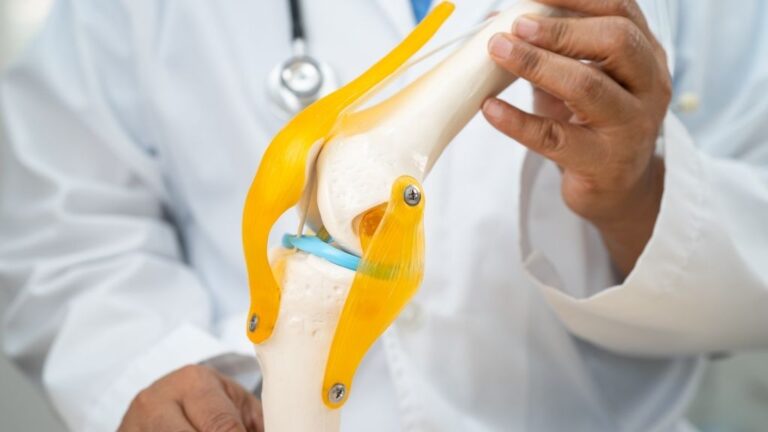
Knee osteoarthritis is a degenerative joint condition in which the cartilage that cushions the ends of the bones gradually breaks down. In the early stages the cartilage thins; in advanced knee osteoarthritis it is largely lost, the space inside the joint narrows, bony spurs (osteophytes) form around the edges and the bone underneath becomes hardened and misshapen. This is often described as “bone-on-bone” arthritis.
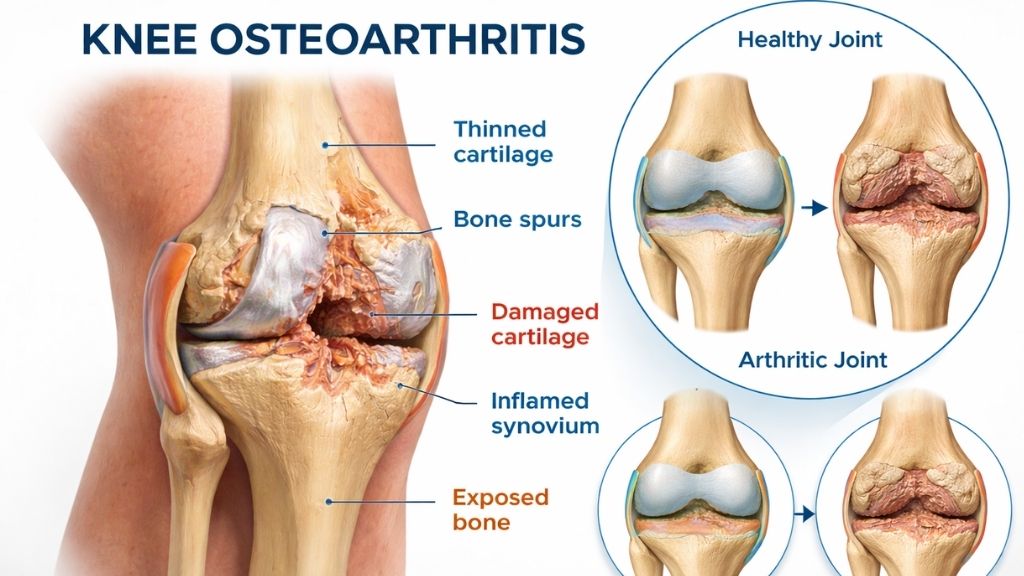
Specialists often grade osteoarthritis on X-rays from 0 to 4. Grade 4, or severe osteoarthritis, means marked narrowing of the joint space, large osteophytes and clear changes in the shape of the bone. At this point the damage cannot be reversed, so treatment focuses on relieving pain and restoring function in a lasting way.
Signs that your knee osteoarthritis is advanced
The X-ray tells only part of the story. What usually matters most to patients, and to their surgeon, is how much the knee affects daily life. Common signs of advanced knee osteoarthritis include:
- Pain that is present most days, including at rest or at night, and disturbs your sleep.
- Stiffness that makes it hard to bend or fully straighten the knee.
- Swelling that keeps coming back, sometimes with a grinding or crunching feeling.
- A knee that feels unstable or gives way.
- A visible change in the shape of the leg, such as bow legs or knock knees.
- A limp, a shorter walking distance, or difficulty with stairs and getting up from a chair.
- Painkillers, physiotherapy or injections that no longer help as they used to.
Why knee osteoarthritis progresses
Advanced knee osteoarthritis usually develops over many years. Age plays a part, but previous knee injuries, meniscus tears, ligament damage, excess body weight, repetitive strain from work or sport, misalignment of the leg and family history can all speed up cartilage loss. Once the joint surfaces are badly worn, the uneven load on the knee tends to make the damage progress further.
How advanced knee osteoarthritis is diagnosed
Diagnosis starts with a clinical examination: how much pain you have, how far you can walk, how well the knee bends and straightens, and whether it is stable. Standing X-rays are the key test, because they show how much joint space is left and how the leg is aligned. An MRI scan is sometimes requested to look at the meniscus, ligaments or bone, but it is not always needed to confirm advanced osteoarthritis.
If you are considering treatment in Spain, recent X-rays and specialist reports allow a surgeon to give an initial opinion before you travel. Our checklist of medical documents before surgery in Spain explains what to prepare.
Non-surgical treatments: what they can and cannot do
In advanced knee osteoarthritis, non-surgical treatments manage symptoms rather than repair the joint. They remain important, both to help you cope day to day and to prepare your body for surgery if you need it. This is how the main options compare:
| Treatment | What it does | Role in advanced osteoarthritis |
|---|---|---|
| Exercise and physiotherapy | Strengthens the muscles that support the knee and improves movement | Recommended at every stage, and helps recovery if you later have surgery |
| Weight loss | Reduces the load on the joint | Can ease pain and lowers the risks of surgery |
| Painkillers and anti-inflammatory medicines | Relieve pain and swelling | Help for flare-ups, but long-term use has side effects and does not stop progression |
| Steroid injections | Reduce inflammation inside the joint | Relief usually lasts weeks rather than months, and repeated injections are limited |
| Hyaluronic acid and PRP injections | Aim to lubricate the joint or support healing | Evidence of benefit is limited, especially when the cartilage is already lost |
| Braces, insoles and walking aids | Support the knee and shift the load | Can make walking easier while you decide on treatment |
This table is a general guide. Your specialist will recommend the options that suit your knee and your overall health.
Knee arthroscopy (keyhole surgery to “wash out” or tidy up the joint) is not an effective treatment for osteoarthritis on its own and is generally not recommended unless there is a separate mechanical problem, such as a locked knee.
Top surgical treatments for advanced knee osteoarthritis
When pain is constant and non-surgical treatments no longer give enough relief, surgery offers the most reliable long-term improvement. The right operation depends on how much of the knee is damaged, the alignment of the leg, your age and activity level and your general health.
Total knee replacement
Total knee replacement, or knee arthroplasty, is the main treatment for advanced knee osteoarthritis. The worn surfaces of the thigh bone and shin bone are replaced with metal and plastic components, and the kneecap may be resurfaced too. The aim is a stable, well-aligned knee that moves smoothly without pain. Most patients notice a clear reduction in pain and a steady improvement in walking over the following months. Learn more about knee replacement surgery in Spain at Ribera.
Partial knee replacement
If the arthritis affects only one part of the knee, usually the inner side, a partial knee replacement may be possible. It keeps more of your own bone and ligaments and can allow a faster recovery, but it is suitable only for carefully selected patients with stable ligaments and damage limited to one compartment. Our guide to total vs partial knee replacement explains the differences in detail.
Minimally invasive and computer-assisted techniques
Minimally invasive approaches aim to reduce disruption to the muscles and soft tissues, which can help with early pain and mobility. Computer-assisted and robotic-assisted systems help the surgeon plan and position the implant precisely. These techniques can be useful in selected cases, but the most important factors for a good long-term result remain an experienced surgical team, careful planning and a structured rehabilitation programme.
Osteotomy in younger patients
In younger, active patients whose arthritis is limited to one side of the knee, an osteotomy may be considered. The surgeon reshapes the shin bone or thigh bone to shift weight away from the damaged area. It is less commonly used once osteoarthritis is advanced throughout the joint.
Knee replacement at Ribera from €10,000
Send us your X-rays and medical reports. A Ribera orthopaedic specialist will review your case and our team will send you a personalised treatment plan and an itemised quote before you travel.
To understand what affects the final price and what a quote usually includes, read our guide to knee replacement cost in Spain.
When is it time to consider knee replacement?
There is no single age or X-ray result that decides when to operate. Most surgeons recommend considering knee replacement when:
- Knee pain is constant and affects your sleep, work, independence or mood.
- You can no longer walk the distances you need to.
- Non-surgical treatments have been tried and no longer give enough relief.
- X-rays confirm advanced damage to the joint.
- You are well enough for surgery and ready to commit to rehabilitation.
Waiting a long time with severe pain can lead to weaker muscles, reduced fitness and a stiffer knee, which may make recovery harder. If you are unsure whether surgery is right for you, you can request a second medical opinion from a Ribera specialist.
Recovery after knee replacement
Modern recovery protocols focus on getting you moving early. This is what the first months typically look like:
1
In hospital
Most patients stand and take their first steps with a frame or crutches on the day of surgery or the next day, and are discharged after a short hospital stay.
2
First weeks
Daily exercises restore bending and straightening of the knee. Swelling and stiffness are normal and improve gradually.
3
Around 6 weeks
Many patients walk without crutches or with one stick and return to light daily activities. Driving is often possible around this time, once you can make an emergency stop safely.
4
3 to 12 months
Strength, confidence and walking distance keep improving, and the knee continues to settle for up to a year.
For a detailed timeline, read our guide to recovery after knee replacement. If you are travelling for surgery, our article on flying after hip or knee replacement explains when it is safe to fly home and how to prepare.
Knee replacement in Spain for international patients
Waiting lists for knee replacement in the UK and Ireland can be long, and months of pain take their toll on work, sleep and independence. Spain offers planned orthopaedic surgery within a short flight of home, in hospitals used to caring for international patients.
Ribera Health Group performs knee replacement at hospitals including Hospital Ribera IMSKE in Valencia, a centre dedicated to bone, joint and muscle conditions, and Hospital Ribera Virgen de la Caridad in Cartagena. Patients are supported by a multilingual team, receive a medical summary in English and continue their follow-up at home, with online consultations if needed. You can read the profiles of our orthopaedic surgeons on the doctors page and learn more about the orthopaedics and traumatology service.
If you already live in Spain, for example in the Valencia, Alicante or Murcia regions, you can be assessed by an English-speaking team without a long journey. See the full list of Ribera hospitals in Spain.
Knee replacement and the EU Cross-Border Healthcare Directive
Irish residents who are entitled to public healthcare may be able to recover part of the cost of knee replacement in Spain through the EU Cross-Border Healthcare Directive. Patients usually pay the provider first and then claim reimbursement from the HSE, up to the amount the same treatment would cost in the Irish public system. A referral is required, and travel and accommodation are not covered. Read how it works for knee replacement through the HSE or in our guide for Irish patients. Rules can change, so always confirm your eligibility with the HSE before booking.
Take the next step
Living with advanced knee osteoarthritis does not have to mean accepting constant pain. A specialist assessment can tell you whether knee replacement, another operation or a better non-surgical plan is the right path for you. Send your X-rays and reports to Ribera Care International and our team will guide you through your options, your recovery plan and the cost before you travel.
Medical information notice: this article is for general information only and does not replace personalised medical advice. Recovery times are approximate and vary from person to person. Whether knee replacement or another treatment is suitable for you must be decided by a qualified orthopaedic specialist after an individual assessment.